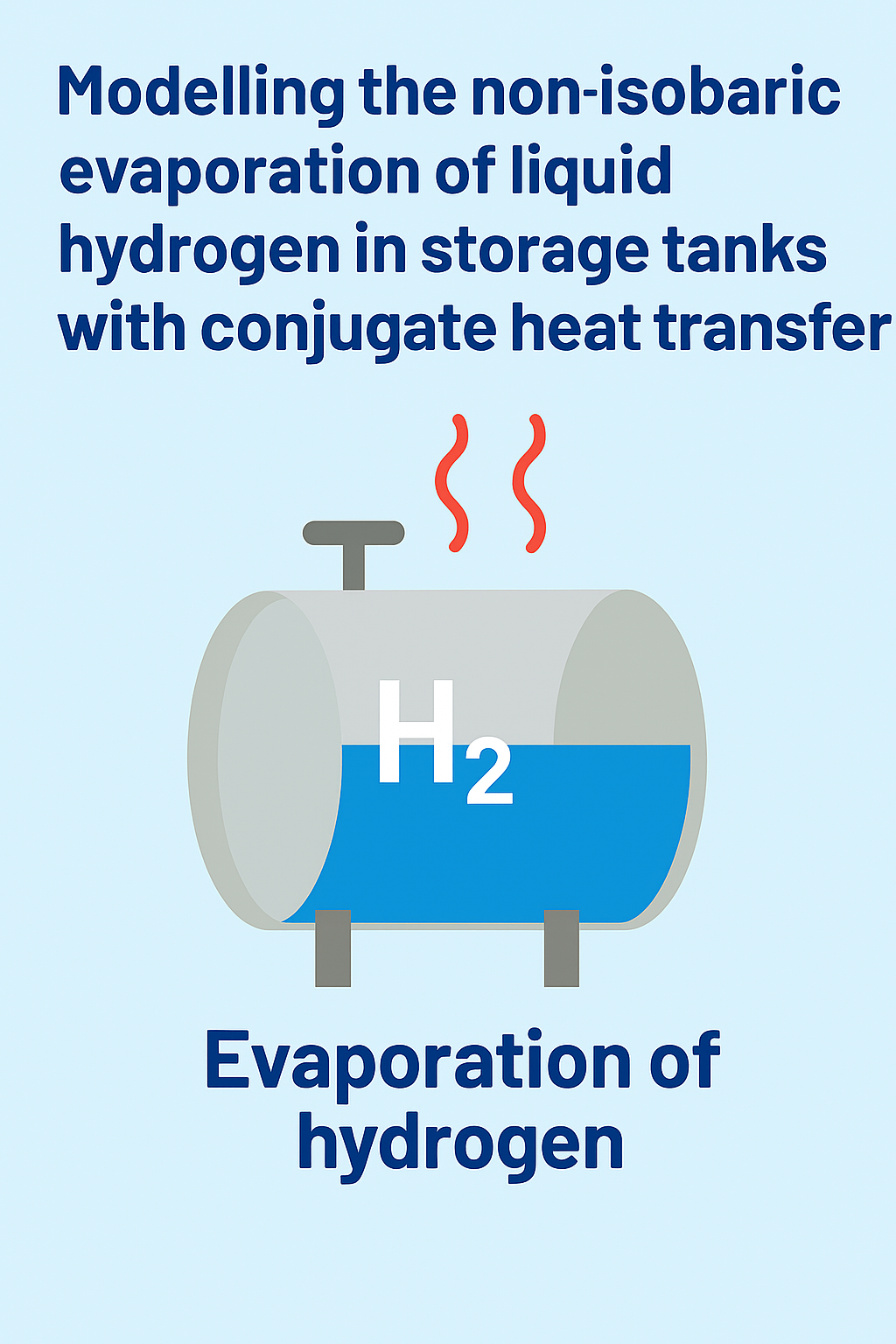
Modelling the non-isobaric evaporation of liquid hydrogen in storage tanks with conjugate heat transfer - 2024/2026
This proposal is based on the hypothesis that it is possible to develop a reduced-order, accurate, and predictive model for the non-isobaric evaporation of liquid hydrogen (LH₂) in storage tanks. The model aims to predict the boil-off gas generation rate as a function of pressure, and the spatial and temporal profiles of temperature and velocity in both the liquid and vapor phases. In particular, it will elucidate how these variables affect the spatiotemporal profile of heat flux at the tank walls, which governs evaporation rates and has not been thoroughly investigated. Computational fluid dynamics (CFD) models of varying complexity will be used to validate and balance the assumptions of simplified models. The methodological approach focuses on developing rigorous submodels for conjugate heat transfer to clarify the interaction between phenomena such as thermal stratification, wall boiling, and surface evaporation.
The novelty of this research lies in its comprehensive treatment of conjugate heat transfer phenomena under non-isobaric storage conditions—a regime more representative of small- and medium-scale industrial applications. Despite over a century since the invention of cryogenic vessels and decades of model development, a robust predictive tool for this type of storage is still lacking. Reducing the model from multiphase simulations to a one-dimensional, multi-domain formulation will not only help identify dominant phenomena but also drastically reduce computational time, enabling the design and operational optimization of LH₂ tanks in real industrial contexts.
Funding Program: FONDECYT Initiation Grant
Project Duration: 24 months
Principal Investigator: Felipe Huerta Pérez