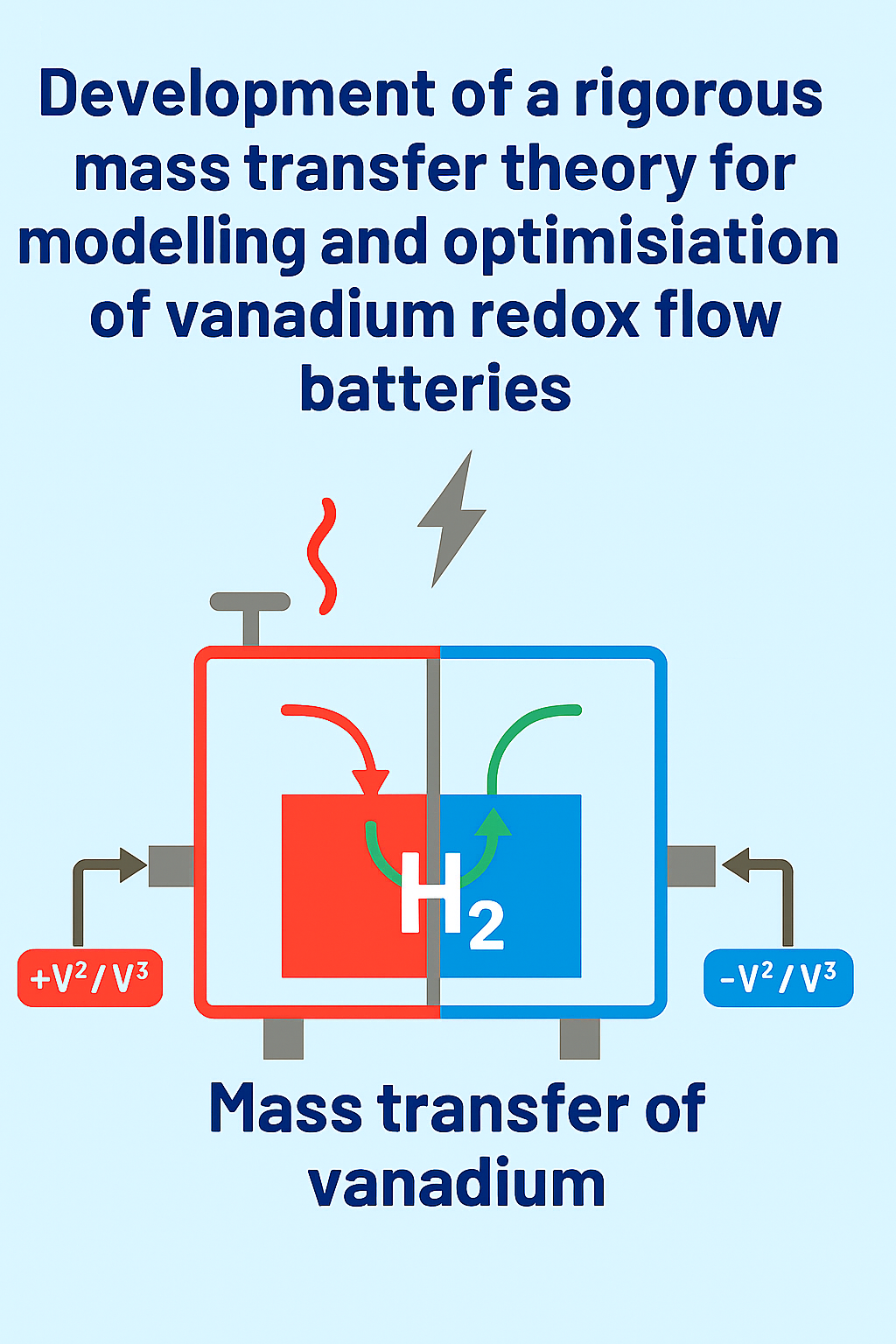
Development of a rigorous mass transfer theory for modelling and optimisation of vanadium redox flow batteries - 2023/2024
Reactor design and optimisation are essential to advancing redox flow battery technology. Mass transport and fluid flow across the interface between distribution channels and the electrode—where reactions occur—directly impact battery performance by controlling reactant permeation and determining conversion rates. This project aimed to improve understanding of interfacial mass transfer using computational fluid dynamics (CFD), enabling the development of engineering equations useful for industrial scaling and multiscale modelling frameworks.
Over the course of the one-year project, a CFD model was successfully implemented using the open-source library OpenFOAM. The model included free electrolyte flow through a rectangular channel in contact with a porous electrode, where a first-order chemical reaction was considered. A sensitivity study was conducted to evaluate the effects of channel aspect ratio, reaction rate, and electrode microstructure. This initial model helped clarify the formation of two boundary layer zones and analyze the changing concentration gradient of the reactant along the axial direction, driven by electrolyte permeation, reaction, and backflow from the porous region into the channel.
A scientific article is currently being finalized, detailing the modelling methodology and findings on transport phenomena. The project is also continuing with the support of a master's student under joint supervision. This next phase will adapt the initial model to incorporate electrochemical reactions and the specific chemistry of vanadium electrolytes. Another key contribution was the development of two free workshops for chemical engineering and related disciplines, each with approximately 30 participants. One was held at Pontificia Universidad Católica in late 2023, and the other at Imperial College London in July 2024. These two-day workshops focused on introductory training in OpenFOAM and included explanatory lectures, guided live demonstrations, and hands-on sessions.
Funding Program: International, Royal Society Exchanges 2023
Project Duration: 12 months
Principal Investigator: Felipe Huerta Pérez