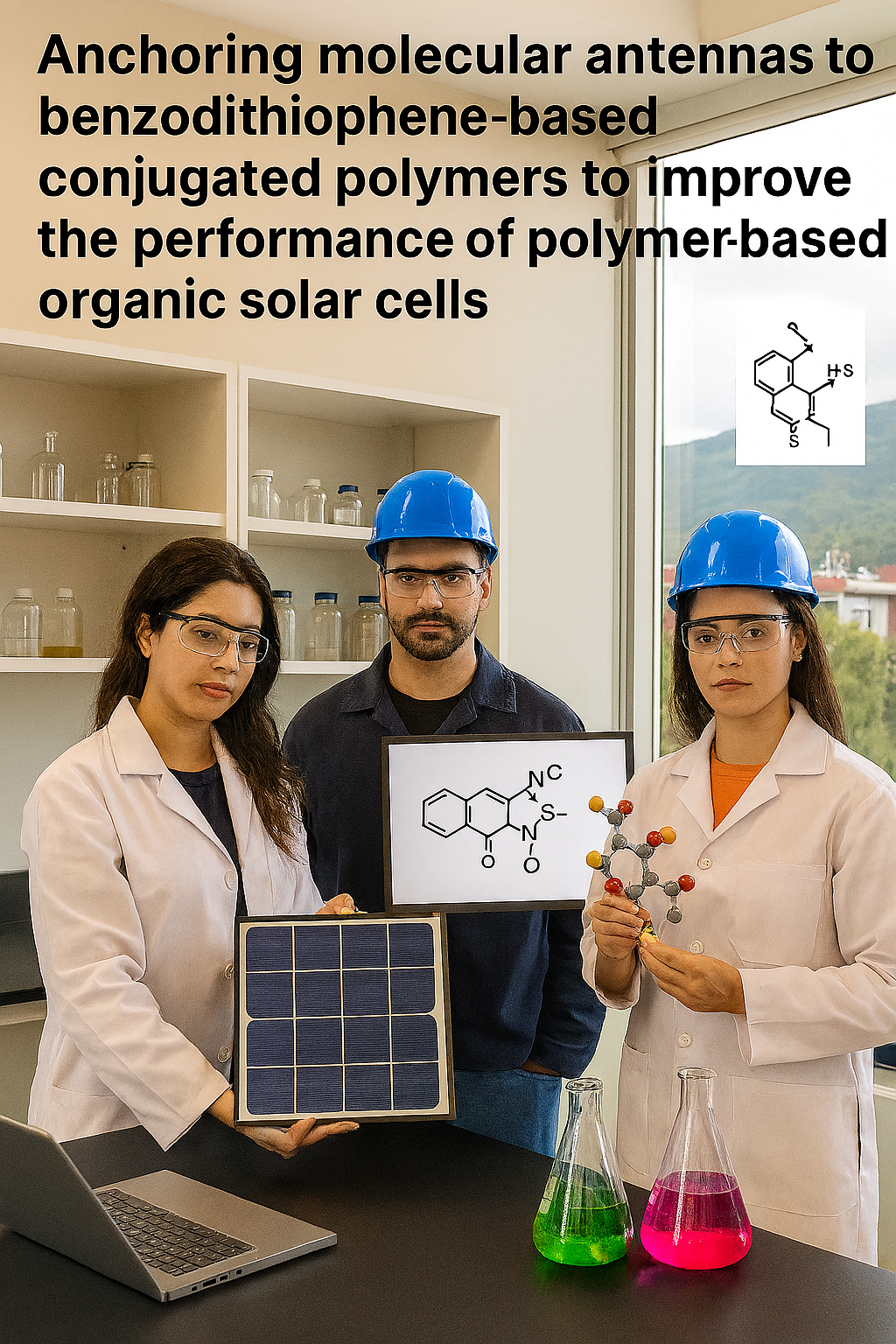
Anchoring molecular antennas to benzodithiophene-based conjugated polymers to improve the performance of polymer-based organic solar cells
This project proposes enhancing the efficiency of organic solar cells (OSCs) through the incorporation of molecular antennas anchored to benzodithiophene-based conjugated polymers. Molecular antennas are structures capable of capturing light at specific wavelengths or amplifying photon absorption, which can increase the overall solar energy conversion efficiency.
The strategy involves synthesizing conjugated polymers containing benzodithiophene units—a building block widely used in OSCs due to its strong absorption, efficient charge transport, and stability—and chemically functionalizing or modifying them by adding antenna molecules. These antennas can help extend the absorption range, improve exciton transfer, reduce recombination losses, and optimize charge carrier generation.
After synthesis, the materials will be characterized (absorption spectra, fluorescence, charge transport, morphology), organic solar cells will be fabricated using these modified materials, and their performance will be evaluated (conversion efficiency, stability, productivity under real-world conditions).
The ultimate goal is to achieve OSCs with higher photovoltaic efficiency, improved long-term stability, and reduced energy losses, contributing to the development of more commercially viable organic solar technologies. Such materials hold potential for flexible, lightweight applications, more economical production, and a reduced environmental footprint compared to traditional silicon-based technologies.
Grant Program: FONDECYT
Project Duration: 36 months
Principal Investigator: Dr. Felipe Angel